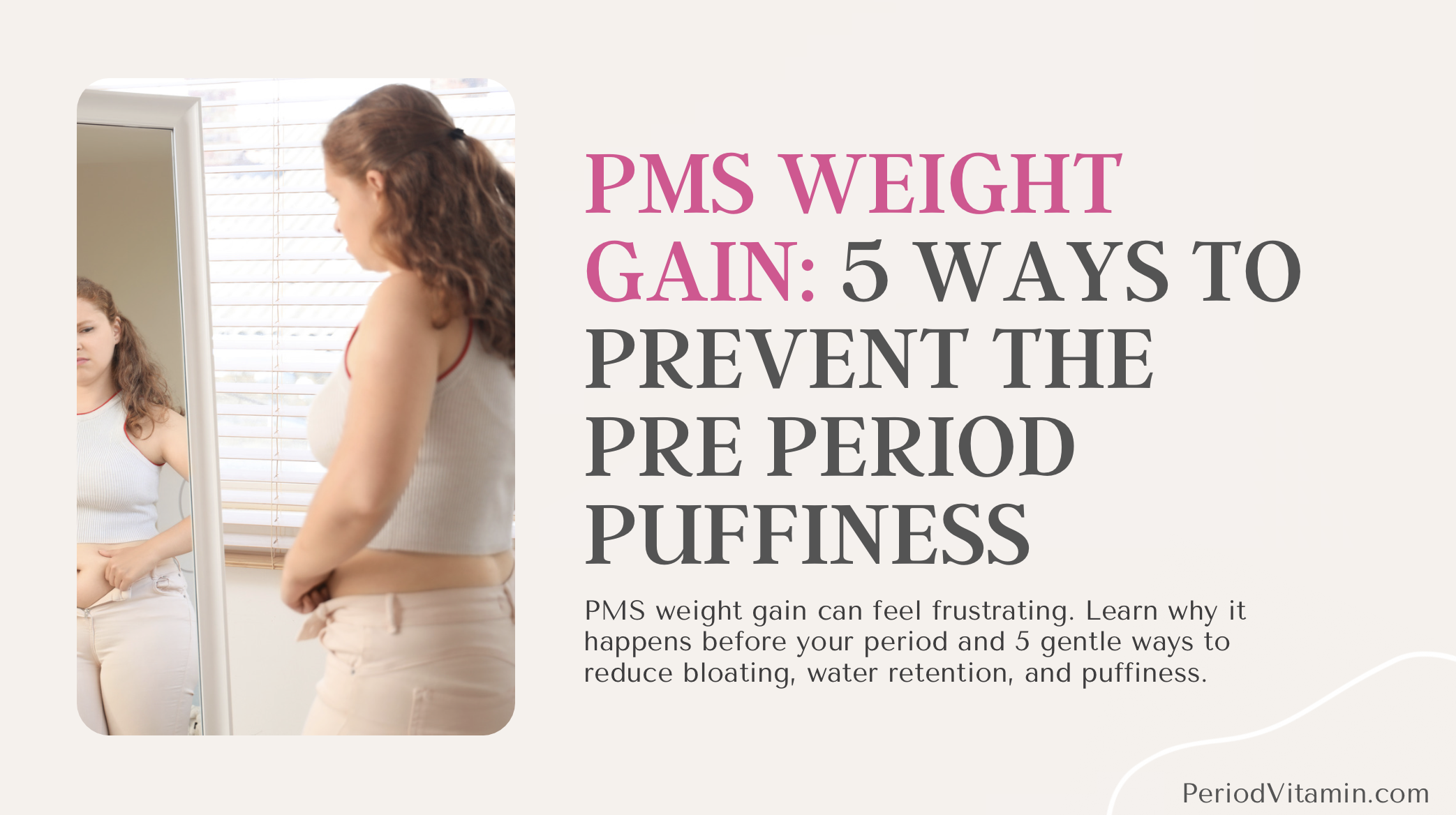
You know that moment a few days before your period when you step on the scale and your stomach drops a little before you even look at the number?
It is not just the number itself. It is the confusion that comes with it. Because you know you have been eating normally. You have not suddenly changed your habits. And yet your jeans feel tighter, your stomach looks softer, and even your rings might feel like they are pressing into your fingers in a way they were not last week.
It can feel like your body has quietly changed overnight, and it is incredibly easy in that moment to assume the worst: I must have gained weight.
But here is something that often brings a small sense of relief once you really understand it. What you are experiencing around your period is very often not fat gain in the way we usually think about it. It is more like your body temporarily holding onto water, shifting digestion, and reacting to hormonal changes that are happening behind the scenes whether you notice them or not.
Estrogen and progesterone naturally rise and fall across your cycle, and PMS can bring symptoms such as bloating, appetite changes, food cravings, breast tenderness, and that generally heavier or puffier feeling. The Office on Women’s Health explains that bloating and appetite changes are common PMS symptoms.
And once you realize that, something important shifts. You stop treating every pre period scale change like a problem you need to fix with restriction or extra workouts. Instead, you start recognizing a pattern your body has been repeating all along.
So let’s talk about what actually helps when PMS weight gain shows up, not in a harsh or restrictive way, but in a way that makes your body feel a little more comfortable and a little less confusing.
1. Notice the salt before you assume it is “fat gain”
There is a very specific kind of frustration that comes with PMS bloating. You feel puffy, your stomach feels tight, and your first instinct is often, I must have eaten too much.
But if you pause for a moment, you might realize something else is going on. Think about those few days before your period. You are more tired than usual, so cooking feels like a chore. You grab takeout because it is easy. You snack on chips without really thinking about it. Maybe you have a frozen meal or soup because it is comforting and quick.
None of that is “bad.” But it can quietly increase your sodium intake without you even realizing it, and salty foods can contribute to water retention. In fact, Mayo Clinic recommends limiting salty foods when premenstrual water retention is bothering you.
This is where things start to click for a lot of women. It is not that you suddenly “gained weight.” It is that your body is already in a hormonal phase where it is more prone to holding fluid, and then a few higher-sodium meals layer on top of that.
You do not need to obsess over salt or eat bland food. That is not the goal at all. But it can help to gently balance things out during that pre period window. Cooking a few more simple meals at home, choosing fresh foods when you can, and adding potassium-rich foods like bananas, potatoes, beans, yogurt, and leafy greens can all help your body feel a little less “stuck” in that puffy state.
Sometimes the difference between feeling bloated and feeling okay is not about eating less. It is just about giving your body a slightly easier load to process.
2. Don’t wait for cravings to “take over” your day
If you have ever had one of those PMS days where you start off trying to be “good” with food and end the evening standing in the kitchen eating something sweet while also looking for something salty, you are definitely not alone.
There is a very real pattern that happens for many women. Appetite changes during PMS are not imagined. They are recognized symptoms of the premenstrual phase, and they can make your usual eating habits feel completely different.
What often makes it harder is not the cravings themselves, but the way we respond to them. A lot of women unintentionally under-eat earlier in the day, thinking they are being disciplined or “balancing things out,” only to find that by late afternoon their hunger feels intense and slightly chaotic.
And that is when PMS eating can feel out of control. Not because you lack willpower, but because your body is finally catching up to what it actually needs.
This is where a small shift in approach can make a big difference. Instead of trying to resist your appetite later in the day, you can support it earlier.
Think about meals that actually keep you full, not just meals that feel “light enough.” Protein, fiber, and healthy fats matter more than ever during this time. A real breakfast with eggs and toast will hold you differently than coffee and a snack bar. A proper lunch with grains, vegetables, and protein will change how your evening feels in a way you can actually notice.
And if you always want chocolate before your period, that is not a character flaw. That is a pattern. You are allowed to plan for it instead of fighting it.
There is a big difference between eating chocolate because you are enjoying it and eating chocolate because your body is underfed, tired, and looking for quick comfort all at once.
3. Keep moving, but let it look different
One of the most relatable PMS experiences is suddenly not wanting to do the workout you normally enjoy. Your body feels heavier, your energy is lower, and even the idea of intense exercise can feel like too much.
And then the guilt can creep in. If I don’t work out, I’ll feel worse. I’ll gain weight. I’ll lose progress.
But your body during PMS is not asking for punishment. It is asking for support.
Movement still helps during this phase, but it does not have to look like your usual routine. In fact, forcing yourself into high intensity workouts when your body is already feeling tender and fatigued can sometimes make you feel more drained, not better. This is where it helps to redefine what “counts.”
A walk outside absolutely counts. A gentle yoga session counts. A lighter strength workout counts. Even just stretching in your living room while your body feels tight and uncomfortable counts more than you think.
If bloating is what makes you want to skip movement altogether, you may also like these simple exercises for PMS bloating. What matters most is not intensity, but consistency and kindness.
And there is something else that often gets overlooked. When you stop moving entirely because you feel off, your body can actually feel more sluggish and bloated. Gentle movement helps circulation, digestion, and that overall “stuck” feeling that often comes with PMS.
So instead of asking, What is my normal workout today? it can be more helpful to ask, What would feel supportive in my body right now? Some days the answer will be your regular workout. Other days it might be a walk, some stretching, or a gentle yoga routine for period bloating. Both can have a place in your cycle.
4. Drink water, even when you feel puffy
This is one of the most counterintuitive parts of PMS weight gain. When you feel bloated or “waterlogged,” your instinct might be to drink less water so you do not “add to it.”
But your body does not work that way.
When you are slightly dehydrated, your body can actually hold onto more fluid as a protective response. And during PMS, when digestion is already a bit slower and bloating is more common, not drinking enough water can make you feel even more uncomfortable.
What tends to help more is steady, consistent hydration throughout the day. Not suddenly chugging water when you feel bloated, but gently supporting your body all day long.
It can also help to think beyond just drinking water. Foods like cucumbers, oranges, berries, soups, and yogurt all contribute to hydration in a way that feels easier and more natural.
And it is also worth gently noticing what replaces water during PMS week. If more coffee drinks, soda, or alcohol sneak in during this time, that can quietly affect how your body feels, even if you do not immediately connect it to bloating.
The goal is not to “flush” your body or force anything. It is simply to keep your system supported while it is already doing a lot of hormonal work in the background.
5. Stop letting the scale define your PMS week
If there is one habit that can make PMS weight gain feel worse than it actually is, it is weighing yourself at the wrong time in your cycle and treating that number as if it tells the full story.
Because here is what often happens. You weigh yourself at your lightest point in the month, then again right before your period when you are bloated, and suddenly you feel like you have gained weight. But those two numbers are not comparable in a meaningful way.
They are coming from completely different hormonal states.
When you start to notice your own pattern, something really interesting happens. The number stops feeling like a surprise and starts feeling predictable. You might even realize, Oh, I always go up a little right before my period, and then it drops again.
That awareness changes everything. It removes the emotional charge from the scale.
If you do like tracking your weight, it becomes much more useful to compare similar points in your cycle rather than random days. That way you are actually seeing trends instead of reacting to temporary fluctuations.
And once you understand your pattern, you stop needing to “fix” it every month.
So is PMS weight gain something you can prevent?
Not completely, and honestly, that is an important thing to accept gently rather than fight against.
Your hormones will shift every month. Your body will hold a little more water at certain times. Your digestion will slow down slightly. That is part of being in a cycling body.
But what you can influence is how intense and uncomfortable it feels.
You can support your body with steady meals instead of chaotic eating. You can keep moving in a way that feels kind instead of punishing. You can stay hydrated. You can be mindful of salt without becoming restrictive. And you can stop treating every small fluctuation as a problem to solve.
And if it doesn’t go away after your period?
This is where paying attention to your pattern really matters.
If your weight and bloating tend to rise before your period and settle again afterward, the timing itself gives you useful information.
But if weight changes continue beyond your period, become progressively more noticeable, or are accompanied by other new symptoms, it is worth talking with your healthcare professional rather than automatically assuming PMS is responsible.
For example, thyroid conditions can affect weight as well as menstrual patterns, and the Office on Women’s Health has a helpful overview of thyroid disease in women.
Your body deserves attention when something feels genuinely different, not just reassurance that everything must be hormonal.
Your body is not changing overnight, even when it feels like it is
There is something deeply comforting about finally understanding this part of your cycle. Because once you do, those pre period days stop feeling like a mystery you have to solve every month.
Your jeans feel tighter? You understand that bloating and fluid may be part of the picture.
The scale goes up? You know the number may not mean what you initially thought it meant.
You want different foods than usual? You recognize that appetite and cravings can shift during PMS rather than immediately blaming yourself for lacking discipline.
And instead of fighting your body during this time, you start working with it. Gently. Consistently. Without panic.
That shift alone can make PMS feel a lot less overwhelming than it used to.
If you are looking for broader nutritional support throughout your cycle, you can also learn more about Period Vitamin and the nutrients and herbs included in the formula.