If your lower back starts aching around the time of your period, you are certainly not alone.
Back pain can accompany menstrual cramps, especially during the first few days of menstruation. For some women, it feels like a dull, heavy ache across the lower back. For others, the discomfort seems to spread from the pelvis into the hips and back.
While yoga cannot address every cause of back pain, gentle movement and stretching may help you feel more comfortable during your period. Yoga can encourage relaxation, reduce muscle tension, and provide gentle movement when an intense workout does not sound appealing.
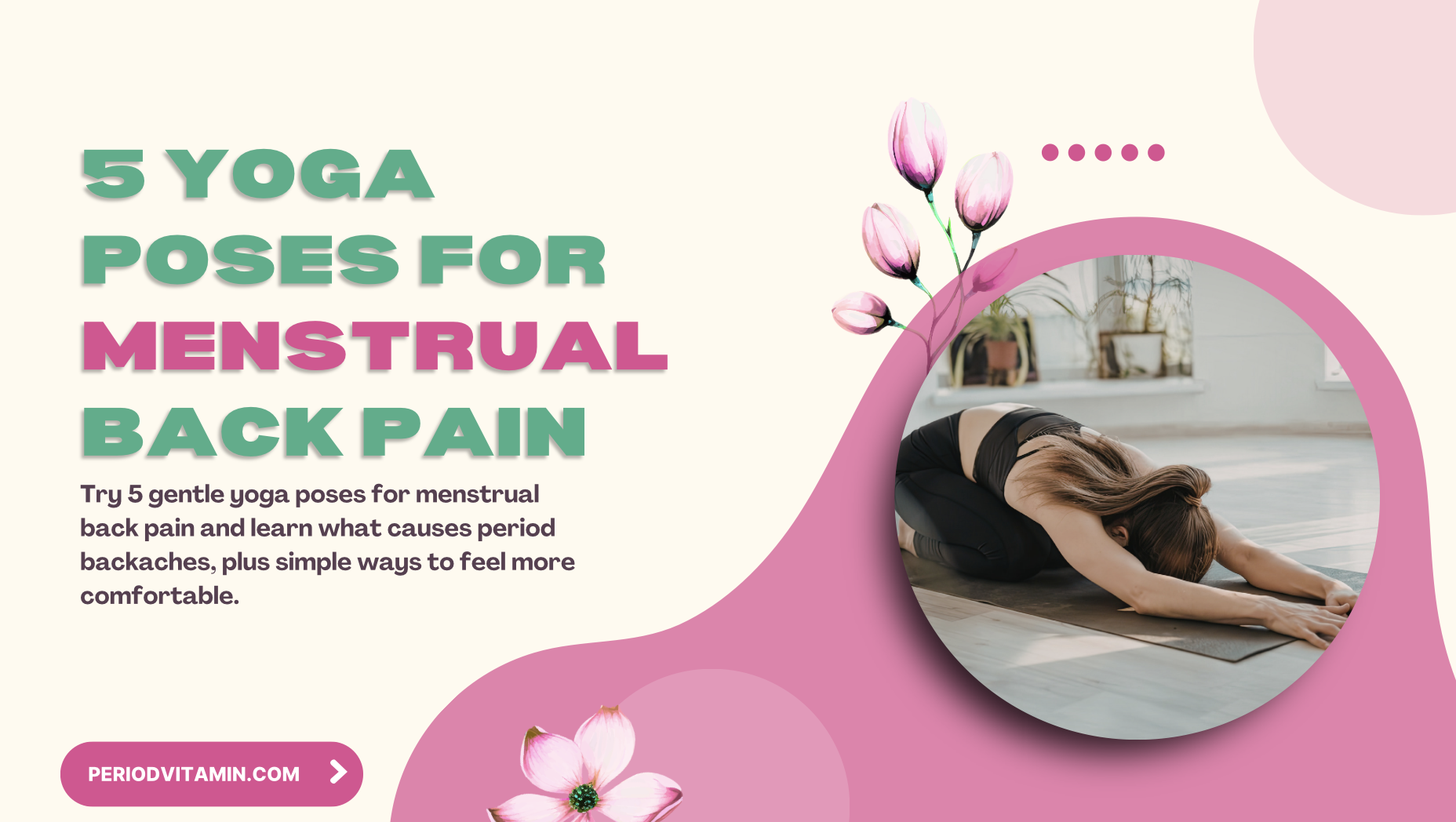
If you are looking for natural ways to manage menstrual discomfort, here are five gentle yoga poses worth trying.
Why Does Your Back Hurt During Your Period?
Menstrual back pain is often connected to the same process that causes period cramps.
Before and during menstruation, the body produces compounds called prostaglandins. These help the uterus contract so it can shed its lining. Higher levels of prostaglandins are associated with stronger menstrual cramps. The American College of Obstetricians and Gynecologists explains that menstrual pain can include cramping in the lower abdomen as well as pain that spreads to the lower back and thighs.
Sometimes that discomfort is felt not only in the lower abdomen but also in the lower back, hips, or upper thighs.
Muscle tension, changes in activity, digestive discomfort, and spending more time sitting or lying down when you do not feel well may also contribute to how your back feels during your period.
For more ideas, read our guide to menstrual back pain relief.
Can Yoga Help With Period Back Pain?
Gentle yoga may be a useful part of your period self care routine.
Research on yoga and menstrual symptoms suggests that yoga may help reduce menstrual pain in some women, although studies vary in quality and the specific yoga practices used. The National Center for Complementary and Integrative Health notes that research suggests yoga may have benefits for several aspects of wellness, including stress management, sleep, balance, and some types of pain.
It is better to think of yoga as a supportive comfort strategy rather than a guaranteed treatment for menstrual back pain.
Research on yoga and menstrual symptoms suggests that yoga may help reduce menstrual pain in some women, although studies vary in quality and the specific yoga practices used. It is better to think of yoga as a supportive comfort strategy rather than a guaranteed treatment.
The goal is not to force your body into a deep stretch.
During your period, slow and comfortable movements may feel much better. Pay attention to your body, breathe normally, and stop if a position increases your pain.
1. Cat Cow Pose
Cat Cow gently moves your spine through flexion and extension and can feel especially soothing when your lower back feels stiff.
Begin on your hands and knees with your wrists underneath your shoulders and your knees underneath your hips.
As you exhale, gently round your back toward the ceiling and allow your head to lower comfortably.
Then slowly move in the opposite direction, allowing your abdomen to move toward the floor while gently lifting your chest.
Continue moving between the two positions slowly with your breath.
There is no need to create an extreme arch. Small, comfortable movements are enough.
Try: 5 to 10 slow repetitions.
2. Gentle Seated Forward Fold
A seated forward fold can provide a gentle stretch through the back of the body, including the lower back and hamstrings.
Sit comfortably on a yoga mat with your legs extended in front of you.
Rather than trying to grab your feet, slowly hinge forward from your hips and reach toward your legs only as far as feels comfortable.
If your hamstrings feel tight, bend your knees slightly. You can also place a folded blanket underneath your hips.
Avoid pulling yourself aggressively into the stretch.
Try: Hold comfortably for about 20 to 30 seconds while breathing slowly.
3. Child’s Pose
Child’s Pose is one of the simplest yoga positions to try when you want gentle movement without a lot of effort.
Begin on your hands and knees, then slowly bring your hips back toward your heels.
Allow your torso to lower toward the floor. Your arms can reach forward or rest comfortably beside your body.
If bringing your hips all the way to your heels is uncomfortable, place a pillow or folded blanket underneath you for support.
Take several slow breaths and allow your back to relax.
Try: Stay for 30 seconds to a minute, or for as long as the position remains comfortable.
4. Legs Up the Wall
Legs Up the Wall is a restorative yoga position that requires very little effort, which can make it particularly appealing on days when you feel tired or uncomfortable.
Sit sideways next to a wall, then carefully lower your upper body toward the floor while bringing your legs up against the wall.
Your body does not need to form a perfect 90 degree angle. Move farther away from the wall if your hamstrings feel tight.
Allow your arms to rest wherever they feel comfortable and simply breathe.
Unlike the original version of this exercise, you do not need to repeatedly point your toes. The benefit of this position comes primarily from resting comfortably.
Try: Relax in the position for 2 to 5 minutes.
5. Knees to Chest
Knees to Chest is another simple stretch that may feel soothing when your lower back feels tight.
Lie comfortably on your back with your knees bent.
Slowly bring one or both knees toward your chest and hold them gently with your hands.
You can remain still or gently rock from side to side if that feels good.
Do not force your knees toward your chest. The position should feel relaxing rather than intense.
Try: Hold for 20 to 30 seconds and repeat as desired.
Make Your Period Yoga Routine Gentle
You do not need a long yoga session to benefit from gentle movement.
Even five or ten minutes may be enough to help you slow down, move stiff muscles, and become more aware of where you are holding tension.
You might combine Cat Cow, Child’s Pose, and Knees to Chest into a short routine. Add slow breathing and give yourself permission to move differently depending on how you feel that day.
Yoga can also be combined with other simple comfort measures such as heat, adequate sleep, hydration, and regular gentle movement.
If back discomfort is a regular part of your cycle, you may also want to read more about back pain during your period.
When Period Back Pain Deserves More Attention
Some menstrual discomfort is common, but severe pain should not automatically be dismissed as normal PMS.
Talk with a healthcare professional if your back or pelvic pain is severe, suddenly becomes worse, regularly interferes with work or daily activities, occurs outside your period, or does not improve with usual self care.
Conditions such as endometriosis, adenomyosis, fibroids, and other pelvic health concerns can sometimes contribute to significant menstrual pain.
Understanding what is causing your symptoms is more important than simply trying to push through them.
Supporting Your Cycle Beyond Yoga
Yoga is only one part of menstrual wellness.
Nutrition, sleep, physical activity, stress management, and understanding your individual symptom patterns can all play a role in how you care for yourself throughout your cycle.
Certain nutrients, including magnesium, calcium, and vitamin B6, have also been studied in relation to premenstrual symptoms. However, supplements should not be presented as an instant way to relax tense muscles or as a substitute for medical care when pain is persistent or severe.
Period Vitamin was created as a convenient way to incorporate targeted vitamins, minerals, and herbal ingredients into a menstrual wellness routine.
It is not a quick fix for menstrual back pain. Instead, it can be one part of a broader approach to supporting your nutritional needs and menstrual wellness throughout your cycle.
Gentle movement. Thoughtful nutrition. Better awareness of your symptoms.
Sometimes caring for your period starts with giving your body a little more attention throughout the entire month.