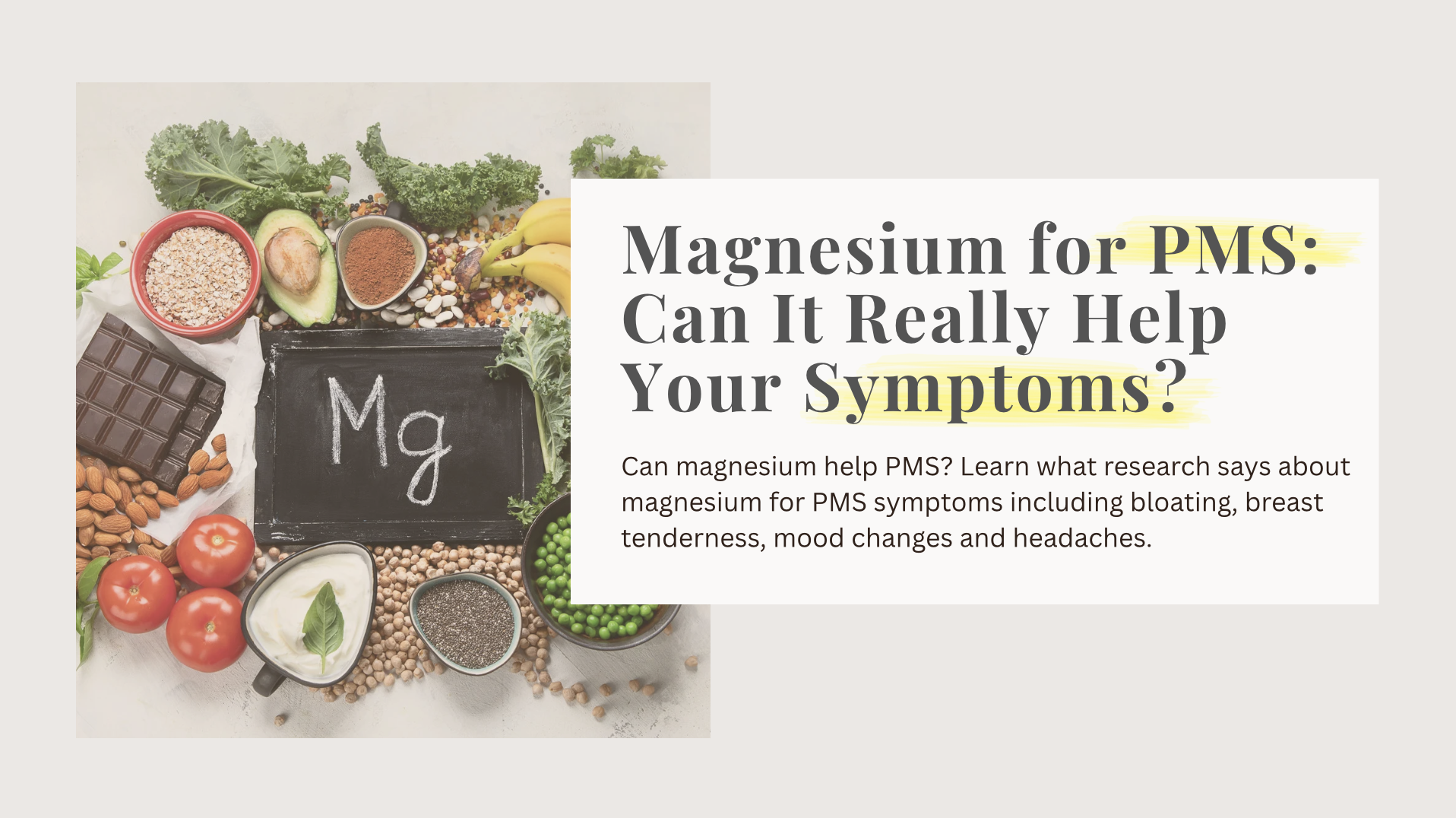
If you have ever found yourself standing in the supplement aisle wondering whether magnesium might help with your PMS, you are certainly not alone.
Magnesium has become one of the most talked about nutrients for women’s health. You will see it recommended for everything from sleep and stress to muscle cramps, headaches, constipation, and PMS.
Some of those claims have more evidence behind them than others.
When it comes to PMS, the story is actually quite interesting.
Magnesium is involved in hundreds of processes throughout the body, including normal muscle and nerve function, energy production, blood sugar regulation, and bone health. And because PMS can involve everything from bloating and breast tenderness to headaches, fatigue, irritability, cravings, and mood changes, researchers have naturally wondered whether magnesium could play a role.
The answer is not quite as simple as “take magnesium and your PMS will disappear.”
But there is enough evidence to make magnesium worth understanding.
First, What Is Actually Happening During PMS?
PMS is not one single symptom.
It is a collection of physical and emotional symptoms that appear during the days before your period and improve around the time menstruation begins.
You might notice that your breasts become tender. Your jeans suddenly feel tighter around your stomach. You may have headaches, cravings, fatigue, irritability, difficulty concentrating, or that familiar feeling that your emotions are simply closer to the surface.
These symptoms tend to occur after ovulation, during the second half of the menstrual cycle.
During this time, estrogen and progesterone change significantly. If pregnancy does not occur, both hormones eventually fall as your body prepares for menstruation.
Researchers still do not completely understand why some women barely notice these hormonal changes while others experience significant PMS symptoms.
What we do know is that PMS is probably not simply a matter of having “too much” or “too little” of one hormone. It appears that some women may be more sensitive to the normal hormonal changes occurring throughout the menstrual cycle.
And nutrition may be one piece of that much larger picture.
So Where Does Magnesium Come In?
Magnesium is an essential mineral, meaning your body needs it but cannot manufacture it on its own.
You have to get it through food, supplements, or a combination of the two.
Magnesium helps regulate normal nerve and muscle function, contributes to energy production, participates in blood sugar and blood pressure regulation, and is necessary for making protein, bone, and DNA.
In other words, magnesium is doing a lot more inside your body than helping you relax before bed.
That becomes particularly interesting when we think about PMS.
Many PMS symptoms involve systems in which magnesium also participates, including the nervous system, muscles, fluid regulation, energy metabolism, and brain signaling.
That biological connection is one reason magnesium has been studied as a possible nutritional tool for PMS.
Does Low Magnesium Cause PMS?
You may have seen claims online suggesting that women with PMS are simply magnesium deficient.
The research does not support making such a broad statement.
A systematic review and meta analysis examining magnesium levels and PMS found no consistent association between serum or red blood cell magnesium levels and PMS overall. The researchers concluded that more well designed clinical trials are needed.
So having PMS does not automatically mean you are deficient in magnesium.
And taking magnesium should not be viewed as “correcting the cause” of PMS.
The relationship appears to be more nuanced.
A woman can have perfectly adequate magnesium status and still experience PMS. Likewise, correcting a nutritional deficiency does not necessarily eliminate the hormonal sensitivity involved in premenstrual symptoms.
Nutrition supports the body.
It does not make us immune to normal hormonal changes.
Can Magnesium Help PMS Symptoms?
Possibly.
The American College of Obstetricians and Gynecologists notes that magnesium supplements may help reduce certain PMS symptoms, including bloating caused by water retention, breast tenderness, and mood symptoms.
The Office on Women’s Health describes the research on magnesium for PMS as mixed.
That is an important distinction.
Magnesium is not a proven cure for PMS, and the scientific evidence is not strong enough to promise that taking magnesium will dramatically change your cycle.
But some women may find it helpful as one part of a broader menstrual wellness routine.
And certain symptoms are particularly interesting.
Magnesium and PMS Bloating
If you feel as though your body suddenly becomes softer, puffier, or heavier before your period, you may be experiencing temporary fluid retention.
Hormonal changes around the menstrual cycle can influence fluid balance, which is one reason rings can feel tighter, breasts may feel fuller, and your stomach may feel more bloated even when your diet has not changed dramatically.
Magnesium has been studied for this aspect of PMS, and ACOG includes reduced water retention among the potential benefits of magnesium supplementation.
That does not mean all period bloating is caused by fluid.
Gas, constipation, changes in appetite, and digestive changes can contribute too.
If your bloating is mainly digestive, addressing your overall diet, hydration, fiber intake, movement, and bowel habits may be just as important as thinking about magnesium.
Learn more Bloating Before Your Period: Why It Happens and What Helps
Magnesium and Breast Tenderness
Breast tenderness is another very common premenstrual complaint.
Some women notice only mild fullness. For others, even putting on a bra becomes uncomfortable during the week before their period.
ACOG also lists breast tenderness among the symptoms magnesium supplementation may help.
Again, think of this as a possible benefit rather than a guarantee.
If breast pain is new, severe, persistent throughout the month, associated with a new lump, or simply feels different from your normal cyclical breast tenderness, it deserves a conversation with your healthcare provider rather than being dismissed as PMS.
Learn more Why Your Breasts Feel Sore Before Your Period
Magnesium and PMS Mood Changes
This is probably where magnesium becomes especially tempting.
You feel irritable.
Everything seems louder.
Small problems feel enormous.
You know intellectually that your period is approaching, but that knowledge does not necessarily make your emotions feel less intense.
Magnesium is involved in normal nervous system function, which has led researchers to investigate whether magnesium intake could influence premenstrual mood symptoms.
There is some evidence suggesting a potential benefit, and ACOG includes mood symptoms among those magnesium may help.
But magnesium should not be presented as an antidepressant or a treatment for severe premenstrual mood changes.
If sadness, anxiety, anger, hopelessness, or emotional changes become severe enough to interfere with your work, relationships, or everyday life, it is important to speak with a healthcare professional.
Severe cyclical mood symptoms can sometimes be related to premenstrual dysphoric disorder, or PMDD, which deserves proper evaluation and treatment.
What About Period Cramps?
This is where PMS and period symptoms often get mixed together.
PMS occurs before menstruation.
Menstrual cramps typically occur around the beginning of menstrual bleeding because the uterus contracts as it sheds its lining.
Magnesium is essential for normal muscle function, so it is understandable that people associate magnesium with cramps.
But we should not automatically assume that because magnesium supports muscles, taking more magnesium will eliminate menstrual cramps.
The evidence for supplements and menstrual pain continues to evolve.
If cramps are severe enough that you regularly miss work, school, exercise, or normal activities, do not simply keep increasing supplements and hoping something eventually works.
Very painful periods can sometimes be associated with conditions such as endometriosis, adenomyosis, or fibroids.
Your symptoms deserve to be taken seriously.
Magnesium and Premenstrual Headaches
Headaches are another common symptom around the menstrual cycle.
For some women they are mild. For others, hormonal changes can trigger migraine.
The Office on Women’s Health notes that magnesium may help some PMS symptoms, including migraine, although the overall evidence regarding magnesium and PMS remains mixed.
If you experience migraines around your period, particularly if they are new, changing, frequent, or disabling, talk with your healthcare provider. Menstrual migraine can often be treated more specifically than simply trying supplements on your own.
Are You Getting Enough Magnesium From Food?
Before we talk about supplements, I like to come back to food.
Not because food magically solves every health problem, but because nutrients work within the context of your overall diet.
For adult women, the recommended daily intake of magnesium is generally around 310 to 320 mg per day, depending on age.
And fortunately, magnesium lives in some wonderful everyday foods.
You will find it in foods such as spinach and other leafy greens, almonds and other nuts, pumpkin and chia seeds, beans and lentils, whole grains, and certain fortified foods.
Instead of asking only:
“Which magnesium supplement should I buy?”
A better first question may be:
“How often am I actually eating magnesium rich foods?”
If breakfast is mostly coffee, lunch is something grabbed between meetings, and dinner is whatever you can find when you are exhausted, your overall nutrient intake may deserve attention before you start building an enormous supplement routine.
Your menstrual cycle does not exist separately from the rest of your health.
How you eat throughout the month matters too.
Should You Take Magnesium Only Before Your Period?
This is another common question.
It is easy to think about PMS nutrition as something you should begin five days before your period.
But your body uses magnesium every day.
Magnesium is not a medication that suddenly switches on when PMS begins. It is an essential nutrient involved in normal body functions throughout the entire month.
This is why I prefer thinking about menstrual nutrition as part of your everyday wellness routine rather than emergency symptom management.
That might mean regularly including magnesium rich foods in your meals.
If you and your healthcare provider decide a supplement is appropriate, consistency may make more sense than treating magnesium as something you remember only when your breasts hurt and your period tracker tells you menstruation is three days away.
Which Type of Magnesium Is Best?
Walk into a supplement store and suddenly magnesium seems unnecessarily complicated.
Magnesium citrate.
Magnesium glycinate.
Magnesium oxide.
Magnesium chloride.
And several others.
Different forms contain different amounts of elemental magnesium and can differ in absorption and digestive effects.
According to the National Institutes of Health Office of Dietary Supplements, forms that dissolve well in liquid tend to be absorbed more completely. Magnesium citrate, chloride, lactate, and aspartate are among the forms that have shown better bioavailability than magnesium oxide and magnesium sulfate.
You may notice that magnesium glycinate is frequently recommended online, particularly for relaxation and sleep. It is a popular form, but marketing claims about one particular form being uniquely superior for PMS often go beyond what the clinical evidence can currently establish.
When choosing a supplement, the form matters.
But the amount of elemental magnesium matters too.
That is the actual amount of magnesium provided by the supplement, and it should appear on the Supplement Facts label.
Do not assume that a product containing a large number of milligrams of a magnesium compound provides that same amount of elemental magnesium.
How Much Magnesium Do Women Need?
For most adult women, the recommended dietary allowance is approximately 310 to 320 mg of magnesium per day.
But there is an important detail here.
That recommendation includes magnesium obtained through food.
The upper limit for magnesium specifically from dietary supplements and medications is 350 mg per day for adults unless a healthcare professional recommends otherwise.
Magnesium naturally present in food does not count toward this supplemental upper limit.
This is one reason I would be cautious about the idea that if a little magnesium is good, a lot must be better.
More is not always better in nutrition.
Can You Take Too Much Magnesium?
Yes.
Magnesium from food is generally not a concern in healthy people because the kidneys help remove excess magnesium.
Supplements are different.
Too much supplemental magnesium can cause diarrhea, nausea, and abdominal cramping.
Extremely high magnesium intake can become dangerous and may affect heart rhythm.
This is especially important for people with impaired kidney function because the kidneys play a major role in regulating magnesium levels.
Magnesium can also interact with certain medications, including some antibiotics and medications used for osteoporosis. Some diuretics and long term acid reducing medications can also affect magnesium status.
If you take prescription medications or have a medical condition, it is worth discussing magnesium with your physician or pharmacist before adding a high dose supplement.
Magnesium Is Not the Whole PMS Story
This may be the most important thing to understand.
PMS is not a magnesium problem.
It is a complex collection of symptoms associated with the hormonal changes of the menstrual cycle.
Magnesium may be one helpful nutritional piece for some women.
But so are adequate nutrition, movement, sleep, stress management, and understanding your individual cycle.
Sometimes we become so focused on finding the supplement that we overlook what our body has been telling us all month.
Maybe you are sleeping five hours a night.
Maybe you are skipping meals and then experiencing intense cravings in the evening.
Maybe you have been under enormous stress.
Maybe you barely eat vegetables, nuts, seeds, legumes, or whole grains.
Or maybe you are doing everything “right” and you still have significant PMS.
That can happen too.
Your symptoms are not a moral scorecard.
They are information.
Start Tracking Your Symptoms
One of the most useful things you can do for PMS costs absolutely nothing.
Track it.
Write down when your symptoms begin, what they feel like, how severe they are, when your period begins, and when the symptoms disappear.
Do this for two or three menstrual cycles.
You may begin noticing patterns that were almost impossible to see when you were relying on memory.
ACOG recommends keeping a symptom record for at least two to three months when evaluating PMS.
That information can also make a conversation with your healthcare provider much more useful.
Instead of saying:
“I feel terrible around my period.”
You can say:
“My bloating starts about six days before my period. My mood changes around four days before. Both improve by the second day of bleeding.”
That is useful information.
So, Is Magnesium Worth Considering for PMS?
For many women, yes.
Just keep your expectations realistic.
Magnesium is an essential mineral your body needs regardless of whether you experience PMS. Getting adequate magnesium through a nutritious diet is an excellent foundation for overall health.
Supplemental magnesium may also help certain PMS symptoms, particularly bloating related to water retention, breast tenderness, and possibly mood symptoms.
But research is still mixed, and magnesium should not be treated as a guaranteed PMS remedy.
Think of it as support rather than a cure.
That distinction may not sound exciting, but it is much closer to how nutrition actually works.
A Gentler Way to Think About PMS
There is a tendency to approach PMS as though your body suddenly becomes a problem that needs fixing every month.
I would encourage you to look at it differently.
Your menstrual cycle gives you information.
When symptoms appear consistently at the same point each month, pay attention to the pattern.
Support yourself before you are miserable.
Eat nourishing foods throughout your cycle. Move your body regularly. Protect your sleep. Notice your stress. Get enough essential nutrients, including magnesium.
And if your symptoms are severe, changing, or disrupting your life, ask for help.
You should not have to spend one week of every month simply enduring your body.
Magnesium may be one small piece of your menstrual wellness routine.
Sometimes the most useful approach is not searching for one miracle ingredient.
It is giving your body consistent support, paying attention to what changes, and building a routine that helps you feel cared for throughout your entire cycle.
Learn More About Supporting Your Cycle
Period Vitamin was created as a convenient way to add targeted nutritional and herbal support to a menstrual wellness routine.
It is not intended to replace a balanced diet, healthy lifestyle, or appropriate medical care.
Frequently Asked Questions About Magnesium and PMS
Magnesium may help some women with certain PMS symptoms. ACOG notes potential benefits for water retention, breast tenderness, and mood symptoms. However, research is mixed, and magnesium should not be considered a guaranteed treatment for PMS.
Magnesium has been studied for symptoms including bloating, breast tenderness, mood changes, and headaches. Individual responses vary, and not every woman will experience improvement.
No. Research has not established that women with PMS are generally magnesium deficient. PMS is complex and appears to involve sensitivity to hormonal changes rather than simply a deficiency of one nutrient.
Good sources include leafy green vegetables, nuts, seeds, beans, lentils, whole grains, and some fortified foods.
Most adult women need approximately 310 to 320 mg of magnesium per day from all sources. Needs vary with age and pregnancy.
Magnesium is an essential nutrient needed every day. However, supplemental magnesium should be used appropriately. The NIH upper limit for magnesium from supplements and medications is 350 mg per day for adults unless otherwise recommended by a healthcare professional.
There is not enough evidence to say that one particular form is definitively the best magnesium for PMS. The NIH notes that magnesium citrate, chloride, lactate, and aspartate tend to be more bioavailable than magnesium oxide and magnesium sulfate.
There is no established timeframe that applies to every woman. PMS research varies in supplement dose, formulation, and duration. Tracking symptoms across several menstrual cycles can help you determine whether a nutritional or lifestyle change appears to be making a meaningful difference.
Medical note: This article is for educational purposes and is not intended to diagnose or treat PMS, PMDD, or another medical condition. Speak with your healthcare provider before beginning a supplement, particularly if you have kidney problems, take prescription medication, are pregnant, or have severe or changing symptoms.